
Plant Historian · OEE

Plant Historian OEE

Overall Equipment Effectiveness

OEE - Reporting (Overall Equipment Effectiveness)
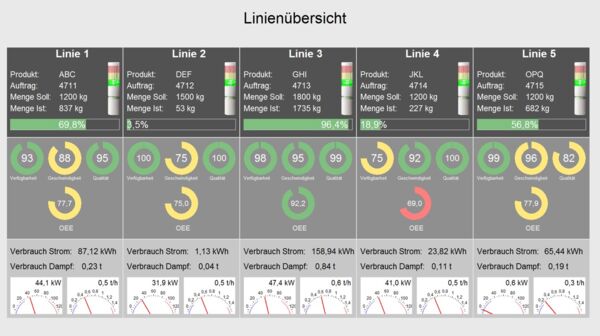
OEE - Overall Equipment Effectiveness - Dashboard
In detail

Plant Historian OEE - Overall Equipment Effectiveness

Reduction of unintended Losses and Plant Standstills - Increase in OEE, Plant Efficiency

Plant Historian OEE provides OEE calculation on the basis of the recorded factors.

OEE is the basis for the representation of the added value factor of each individual plant or production line. The management is offered a more differentiated view of the systems and, consequently, of the added value of the entire production.


increase availability - reduce downtimes

At a glance

Benefits · Core Features · Technologies

Benefits

  • Transparency of machine and production data
  • Increased availability due to direct information forwarding of the machine/plant status to the maintenance/servicing staff
  • Provisioning of data concerning the Continuous Improvement Process (CIP)
  • Transparent presentation of the entire value chain (traceability)
  • Monitoring of machine runtime, standstill, productivity

Core Features

  • Central collection of technical operating data
    (machine data, production data, messages, disturbances, maintenance data, material consumption, etc.)
  • Transparent control and analysis of the whole plant lifecycle
  • Status overview of all plants and machines
  • Evaluation and classification of downtimes (setup times, maintenance, disturbances, cleaning etc.)
  • Automated OEE reporting

Technologies

  • Web functionality
  • Connection via standardized interfaces:
  • M-Bus to TCP/IP
  • Modbus connection (e.g. via RS485)
  • Modbus to TCP/IP
  • 4-20 mA or 0-20 V to TCP/IP (OPC, Modbus etc.)
  • Standardized OPC connection to the PCS/PLC world
  • WeylChem
  • Nutriswiss
  • Thales
  • Global Amines
  • INEOS Styrolution
  • Wacker
  • Siltronic
  • Kalle
  • Clariant
  • Kuraray
FAQ

FAQ – Frequently asked questions

Calculating OEE

What is OEE (overall equipment effectiveness)?

OEE (overall equipment effectiveness) shows what share of the planned production time actually turns into good products. It combines the three types of loss – availability, performance and quality – into a single percentage.

How is OEE calculated?

OEE = availability × performance × quality. Availability = actual run time ÷ planned production time. Performance = (output × ideal cycle time) ÷ run time. Quality = good units ÷ total output.

What does an example OEE calculation look like?

A shift is planned at 480 minutes and the line stops for 60 minutes: availability 420 ÷ 480 = 87.5%. With an ideal cycle time of 1 minute, 380 instead of a possible 420 units are produced: performance 90.5%. 361 of them are good: quality 95%. OEE = 0.875 × 0.905 × 0.95 ≈ 75%.

What is a good OEE value?

85% is often cited as world class; many plants are well below that. How realistic a target is depends heavily on the industry, the equipment and the product mix. The trend of your own plant over time says more than a comparison with other people's figures.

Losses and improvement

Which losses reduce OEE?

Losses are usually grouped into the six big losses: equipment failures and setup and adjustment time reduce availability, idling with minor stops and reduced speed reduce performance, and start-up losses as well as scrap and rework reduce quality.

How can OEE be improved?

First, downtime must be recorded completely and classified by cause, such as setup, maintenance, fault or cleaning. Then the biggest sources of loss can be tackled in a targeted way and the measures tracked via the KPI in the continuous improvement process (CIP). Forwarding the machine status directly to maintenance and support staff also cuts response times.

How does Plant Historian OEE capture the data?

Plant Historian OEE captures machine and production data, messages, faults and maintenance data centrally – via a standardised OPC link to the process control system or PLC, and via Modbus, M-Bus and 4–20 mA signals. Downtime is analysed and classified, and OEE is calculated and reported automatically.

Learn more

Do you need further information?

Then get in touch with us directly.

Contact

Book an intro call Contact

Continue to appointment booking

To book an appointment you leave imes-solutions.com. Booking is handled by the external provider Calendly.